W Marigold St Drainage: 11ft Slope, ADU, Rain Gardens
Drainage plan and hydrology report for an Altadena rebuild on an 11-foot sloping lot: flowlines around the house and ADU, lined rain gardens both sides.

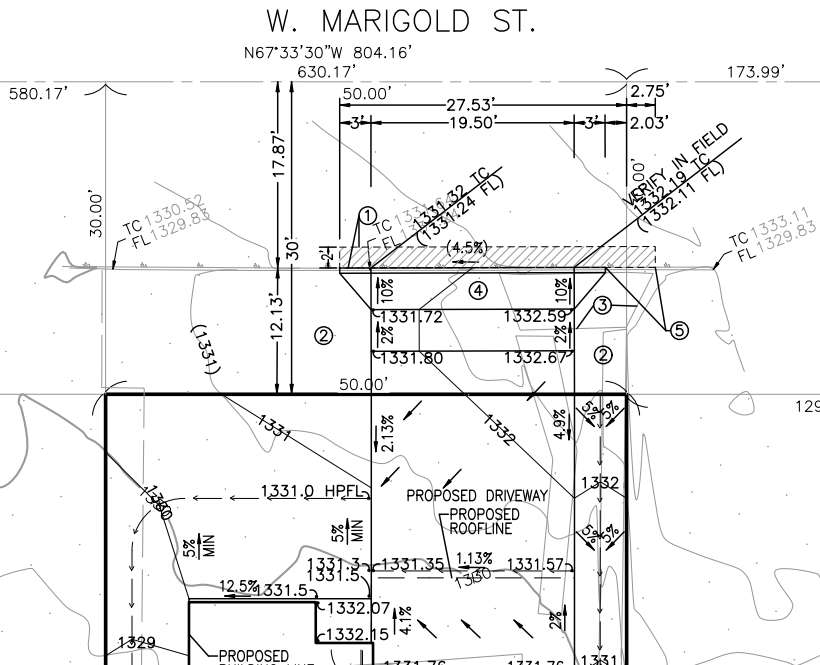
We recently wrapped up a drainage plan and hydrology report for an Altadena fire rebuild on West Marigold Street. The site had an 11-foot slope from the street down to the rear, and the owner was planning a proposed ADU in the back.
This project had some interesting engineering challenges.
The Site Conditions
The site slopes 11 feet from the street down to the rear. The existing house had a driveway that was going to be widened to connect to a proposed attached garage. The owner was also planning an ADU in the rear.
Our job was to design the drainage plan that could handle both the main house and the future ADU, while keeping the pre-fire drainage pattern intact.
How We Handled the Main House
For the main house, we graded at 5% slope, 10 feet away from the structure. We created a flowline around the sideyards that sheets flow to the natural drainage pattern. This keeps water moving away from the foundation without concentrating flow in a way that would cause erosion or pooling.
A short 1-foot curb was introduced on the East side to help flatten out the ADU sideyard and make drainage more manageable.
The ADU Challenge
The proposed ADU in the rear needed to slope down at a maximum of 20% to connect with the rear house patio. We routed a second flowline 10 feet from the ADU at 5% slope, connecting to the rear drainage pattern that existed pre-fire.
When you add an ADU, you add impervious surface. LA County will want to see how that additional runoff is being handled. By designing the flowlines to match the pre-fire drainage pattern, we can show the county that the proposed development does not send more water to neighboring properties than existed before.
Rain Gardens on Both Sides
The West side gets a plastic lined rain garden placed in between to slow and store some stormwater. The East side gets a similar plastic lined rain garden on the South property line.
Neither of these is an LID device. LID devices infiltrate stormwater into the ground and require ongoing maintenance agreements that many owners want to avoid. These rain gardens are storage volume devices. They hold stormwater during a storm and release it once the storage capacity is reached. Because they are plastic lined, they do not infiltrate into the ground.

The Earthwork
The main house slab sits on grade, so we brought in fill to raise the rear of the house and patio to the proper elevation. The ADU sits on an existing 7% slope, so we added fill to level it out.
The image above shows a TIN, which stands for Triangulated Irregular Network. It is how terrain surfaces are represented in civil engineering software. Instead of a grid of elevations, the surface is broken into triangles connecting survey points. Each triangle shows a face of the existing ground or proposed grade, with the numbers at the corners being spot elevations. The yellow shading represents cut and fill depths relative to the proposed grade. This gives us and the contractor a clear picture of exactly how much material needs to be moved before and during construction.

The Hydrology Report
The hydrology report showed that the pre-fire impervious surface was actually greater than the proposed construction. This is common on fire rebuilds where the previous structure had more footprint, pools, or extensive hardscape than what is being proposed in the rebuild.
When pre-fire impervious exceeds proposed impervious, LA County generally does not require pumps or additional drainage controls, as long as the drainage pattern stays similar.
Services Provided
This Altadena fire rebuild with ADU addition required:
- Drainage plans — flowlines around main house and ADU
- Hydrology reports — pre-fire vs post-fire impervious comparison
- Rain garden design on West and East property lines
For Altadena fire rebuild projects, we can look at your specific site and tell you what LA County will likely require before you spend money on designs that might not pass plan check.
No obligation. Just useful information if you are early in the process and trying to figure out what you actually need.
Frequently Asked Questions
Related Portfolio Projects
Related Posts

Rebuilding Altadena
The first Altadena lot since the Eaton Fire sold on Calaveras Street for $100k over asking. What that means for rebuild timing and engineering.
Altadena and SB9
Was doing some networking this week and getting to chit chat with Architects and developers about the fires has been most interesting.

Los Feliz Grading
A Los Feliz plan with a slight addition and ADU, tied into existing topography. Early look at the grading approach for this hillside-adjacent lot.